Blonde hair, blue eyes and fair skin are often treated as a ready-made palette, but the combination has far more variation than a single rack of pale pink jumpers suggests. The useful question is not which colours are allowed. It is which depth, temperature and finish keep your face clear rather than making it disappear before anyone notices your eyes.
Why the same features can need completely different colours
A very light ash blonde with grey-blue eyes usually has low contrast: the hair, skin and eye area sit close together in value. A bright cobalt blouse may look separate from her rather than flattering. A honey blonde with clear turquoise eyes can carry considerably more warmth and clarity, even with equally fair skin. Hair color analysis starts by looking at the whole face in daylight, not by collecting three labels and assigning a universal palette.
Start with the actual tone of your blonde
Cool blonde hair has a pearl, beige-ash, champagne or icy direction. It usually sits well beside softened cool colours: dusty blue, misty lavender, rose beige, soft navy and blue-grey. These shades echo the quietness of the hair without turning the complexion yellow. Very stark optic white can be harsher than a soft white or dove grey, especially when the eyebrows and lashes are light.
Warm blonde hair contains butter, wheat, gold, strawberry or caramel notes. It often benefits from gentle warmth rather than strong orange. Ecru, warm ivory, muted coral, soft apricot, petrol blue and olive can make the hair look deliberate instead of brassy. The practical check is to hold a warm cream and a blue-white top under the chin; the better one will make the skin texture look smoother and the eyes more awake.
Neutral blonde is flexible but still needs a decision about intensity. Beige blonde may wear both soft pink and muted turquoise, while a highlighter-yellow top can overwhelm it. When in doubt, choose a colour with a little grey or cream mixed into it. That slight restraint is often more elegant than chasing the brightest version on the rail.
Use colour to make blue eyes look clearer
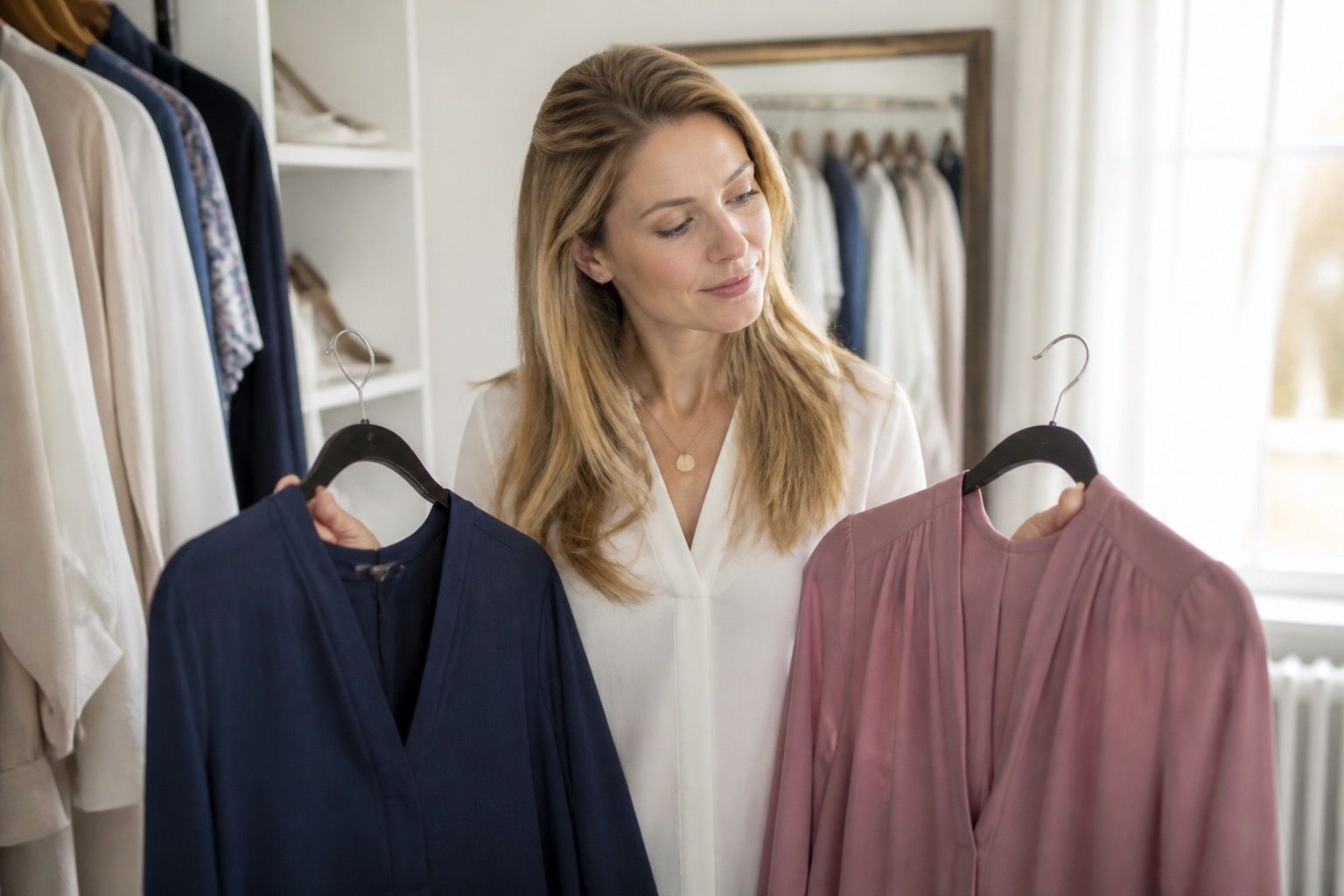
Blue eyes do not need to be matched exactly. In fact, a top in the same flat blue can sometimes make them look less distinct. A neighbouring colour often works better: soft navy for grey-blue eyes, blue-green for aqua eyes, plum for cooler eyes, and muted coral for warmer blue eyes. The contrast is subtle enough to keep the result believable in normal daylight rather than only in a mirror near a window.
Navy deserves a place in almost every wardrobe because it gives definition without the severity of black. Choose inky navy for a clearer, higher-contrast face and softened navy for a delicate ash blonde. Teal is another reliable option, but its undertone matters. A green-heavy teal can suit golden blonde hair; a blue-heavy teal usually feels calmer beside icy shades.
Soft pink is useful when it is selected by temperature. Blue-pink, mauve rose and faded raspberry complement cool blondes. Peachy rose and salmon pink can work with warm blonde, provided the colour is muted enough not to amplify surface redness. Try the shade in a T-shirt before buying a coat; a larger area close to the face reveals much more than a small scarf.
Choose neutrals that do not wash out fair skin
Black is not automatically forbidden, but it asks for contrast. If your hair, brows and lashes are very light, a black crew neck can make the face look unfinished unless there is defined eye makeup, a stronger lip colour or a visible collarbone. Charcoal, soft navy, espresso, deep petrol and cool chocolate give a similar grounded effect with less visual pressure.
White needs the same attention. Icy white can sharpen cool blonde hair and very clear blue eyes, while cream usually makes warm blonde and peachy fair skin look more rested. Neither is morally better. Put each near your jaw rather than against your hand: hands are often more tanned, red or shadowed than the face and can lead to a misleading choice.
For everyday pieces, look for mushroom, stone, taupe, soft camel, blue-grey and light olive. The best neutral will still create an edge between your jaw and the fabric. If everything blends together, choose one step darker or a little cooler. That small adjustment is usually enough to prevent the familiar washed-out photograph taken under office lighting.
Scale prints, metals and makeup with your natural contrast
Print scale is an overlooked part of color analysis hair and wardrobe choices. A very delicate face can be swallowed by a large black-and-white graphic print, even if both colours technically suit the undertone. Smaller patterns with blurred edges, fine stripes and medium contrast often look more coherent with pale hair and fair skin. A clearer blonde with darker brows can handle a crisper geometric print or a strong navy-and-ivory stripe.
Jewellery is a quick experiment, not a verdict. Silver, white gold and pearl often support icy or ash blonde; brushed gold, champagne metal and warm pearls can light up honey blonde. If both metals work, your undertone may be neutral or your contrast may matter more than temperature. Notice the area around the mouth and eyes: the wrong metal often makes shadows look deeper, even when the neck looks fine.
Makeup can change the balance, so test clothes both with your normal routine and with a bare face. A dramatic black eyeliner or bronzer can make a previously difficult colour seem workable, but that does not mean it is an easy weekday option. The most useful wardrobe colours still let the face look alive on a rushed morning.
Test a palette at home before editing your wardrobe
Set aside ten tops, scarves or pieces of fabric in different temperatures and depths. Stand near a window on an overcast day, tie back the hair, and take a front-facing photograph with the same exposure for each option. Avoid a yellow lamp, a beauty filter and a phone screen held too close. Compare the images later as a group; the best colours usually make the eye area look even and the hair look intentional.
Keep notes in plain language: soft navy makes my eyes clearer; bright white makes my cheeks pink; warm cream makes the roots look golden. This is more actionable than trying to diagnose a season from one selfie. You may find that your best clothing colors for blonde hair, blue eyes fair skin split into two families: calm cool colours for work and a few richer blue-green or berry shades when you want more presence.
Build gradually. One good navy knit, one pink that respects your undertone, one reliable light neutral and one coloured layer are enough to test the pattern in real life. Hair colour shifts with toners, sunlight and regrowth, so leave room for adjustment. A flexible palette will keep working when your blonde becomes slightly warmer in summer or cooler after the next salon visit.